

The Collapse of a Bore Hole – A Case Study in Casings
Eagle Drilling Services (Eagle) was recently contracted to drill one 400-foot hole and install a geoloop as part of a thermal conductivity test. To fulfill the contract, the drill team employed an open hole mud rotary method. This method advances fluids, known as drill mud, which includes both bentonite and water, and is recirculated throughout the drilling process. The bentonite swells when added to water and stabilizes the borings, which prevents the walls from collapsing.
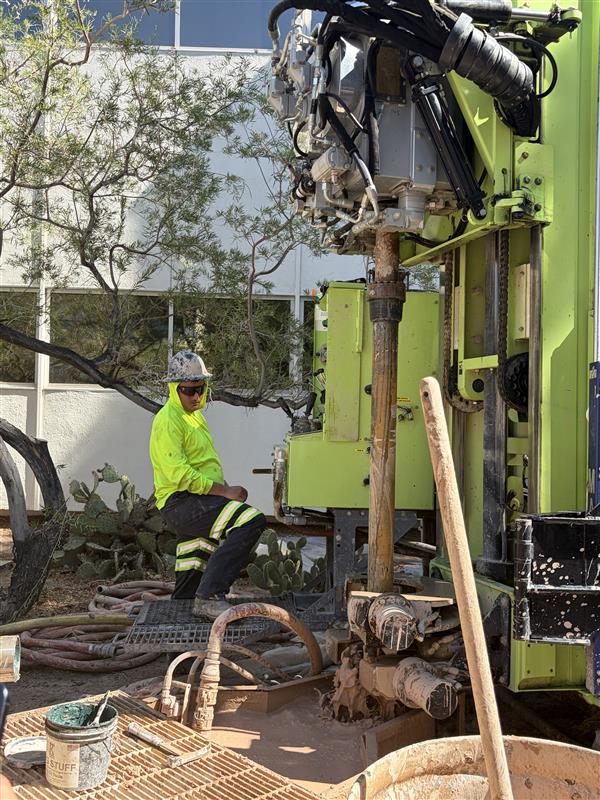 However, on this most recent contract, things went awry. At roughly 200 feet below the surface, there was a sudden and significant loss of drilling fluid. As a result, the drill mud was lost into the voids in the subsurface and could no longer remove soil cuttings from the boring, causing a lack of drilling fluid circulation and the bore hole to collapse in on itself multiple times.
What was the cause? It could have been a layer or pocket of loose gravel, or a collection of fissures that allowed the drilling fluid to escape the boring rather than coat the sides of the hole. Regardless, without a well-constructed borehole, a geoloop could not be installed.
For this reason, the drilling crew pivoted to a sonic percussive drilling method.
While mud rotary drilling requires a traditional auger drilling rig, sonic percussive drilling requires a completely different piece of machinery. Sonic uses vibration, as quickly as 150 times per second, to advance the drill string, which is the column of connected pipes and tools on a drilling rig. This method drills quickly into the ground while using water at the very tip of the drill string. This keeps the drill head clean and can increase the drilling speed. Rotation is added to the drill string to advance it into the ground, and the fluid decreases the heat caused by the intense vibration.
As the Sonic Percussive Method (SPM) drill bit advances, an outer casing is simultaneously vibrated down, which keeps the borehole open and prevents the hole from collapsing. For this project the entire borehole was encased, including the troubling layer at roughly 200 feet below the surface. This ensured the bore hole walls were held open until a geoloop u-bend pipe was able to be installed and grouted into the borehole.
By using this sonic drilling method, the desired depth was quickly achieved, the inner core of soil was removed, the geoloop was installed, and finally the outer casing was removed from the hole as the boring was backfilled.
When the method is deployed correctly, a 400-foot boring can be completed in one or two days, which is much faster than the mud rotary method.
Every project comes with its own unique set of problems and solutions, but we are up for the challenge. Ask Eagle Drilling which method is best for your needs.