

According to the United States Environmental Protection Agency (USEPA), an underground storage tank system (UST) is a tank and any underground piping connected to the tank containing at least 10 percent of its combined volume underground. The USEPA UST regulations apply only to UST systems storing either petroleum products (e.g., gas, diesel, oil, etc.) or certain hazardous substances (e.g., solvents, mixture of waste petroleum, etc.).
A little history! Prior to the 1980s, USTs were unregulated. However, 1983 national attention was directed at petroleum in groundwater as families in Canob Park, Rhode Island were seeing unusual health issues. CBS’ show 60 Minutes did a segment called Check the Water featuring the residents of Canob Park.
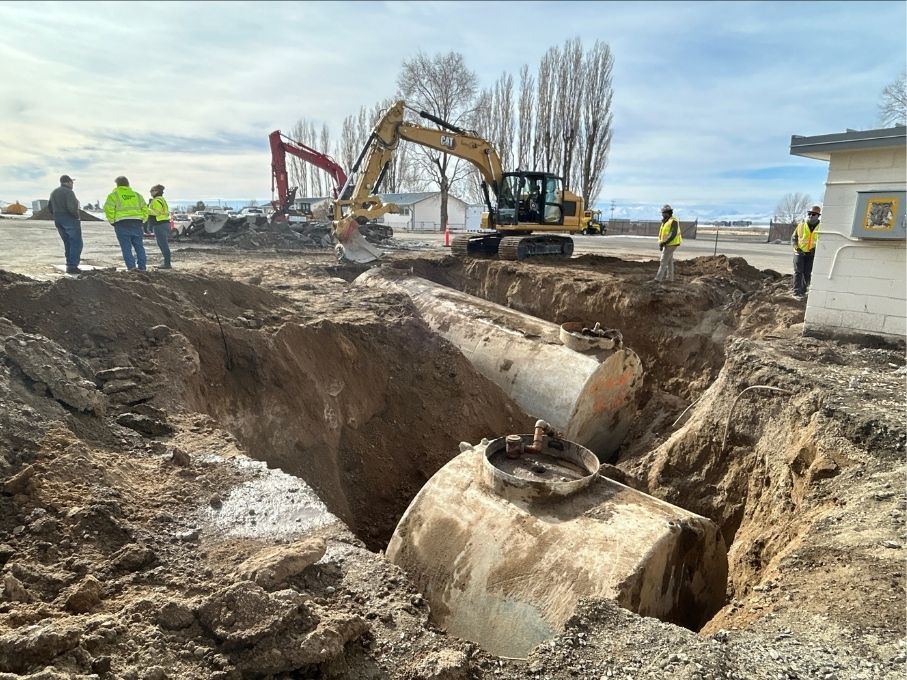
The result of this health and environmental issue coming to light was that by 1984, Congress had passed and added Subtitle I to the Solid Waste Disposal Act through the Hazardous and Solid Waste Amendment. This formed the national UST program and tasked the EPA with creating regulations for storing hazardous substances. One requirement was that existing USTs and USTs installed after May of 1986, storing regulated substances, had to be registered with the USEPA.
In Nevada, the NDEP, Northern Nevada Public Health (NNPH), and the Southern Nevada Health District (SNHD) collaborate to ensure UST inspections are completed statewide.
Some tanks are exempt from registration such as heating oil tanks (HOTs). However, both USTs and HOTs have to be removed and disposed of appropriately. All USTs and some HOTs require notification and closure through local, state, and federal agencies.
Are you interested in buying a property that contains, is adjacent to, or is down gradient from USTs? Were you excavating at your property or project site and you found an unknown object that you suspect is a UST or a HOT? Do you own or operate USTs and suspect they/or the associated system is leaking? Call GES! Asking the question is free! GES works all over Nevada and in parts of Utah and Arizona.
GES supports our partners and clients by providing UST expertise! We perform Phase I Environmental Site Assessments (ESAs) for properties on, adjacent to, and downgradient from properties with USTs. GES performs Phase II ESAs to investigate subsurface conditions that may be impacted by leaking USTs (LUSTs). GES can make recommendations on and oversee the removal, closure, and remediation of your site. We are just a phone call away!